Why Tier 2 GEOs are useful for dating traffic
Tier 1 dating traffic can be expensive and competitive. Tier 3 can bring volume but often lower payouts and less predictable quality. Tier 2 often sits in the middle: affordable enough for testing, but strong enough to produce meaningful CPA performance.
Markets such as Brazil, Poland, Romania, Turkey, South Africa, and selected Asian or LATAM GEOs can work well depending on source, funnel, language, and offer availability.
Use smartlinks for coverage, not blind routing
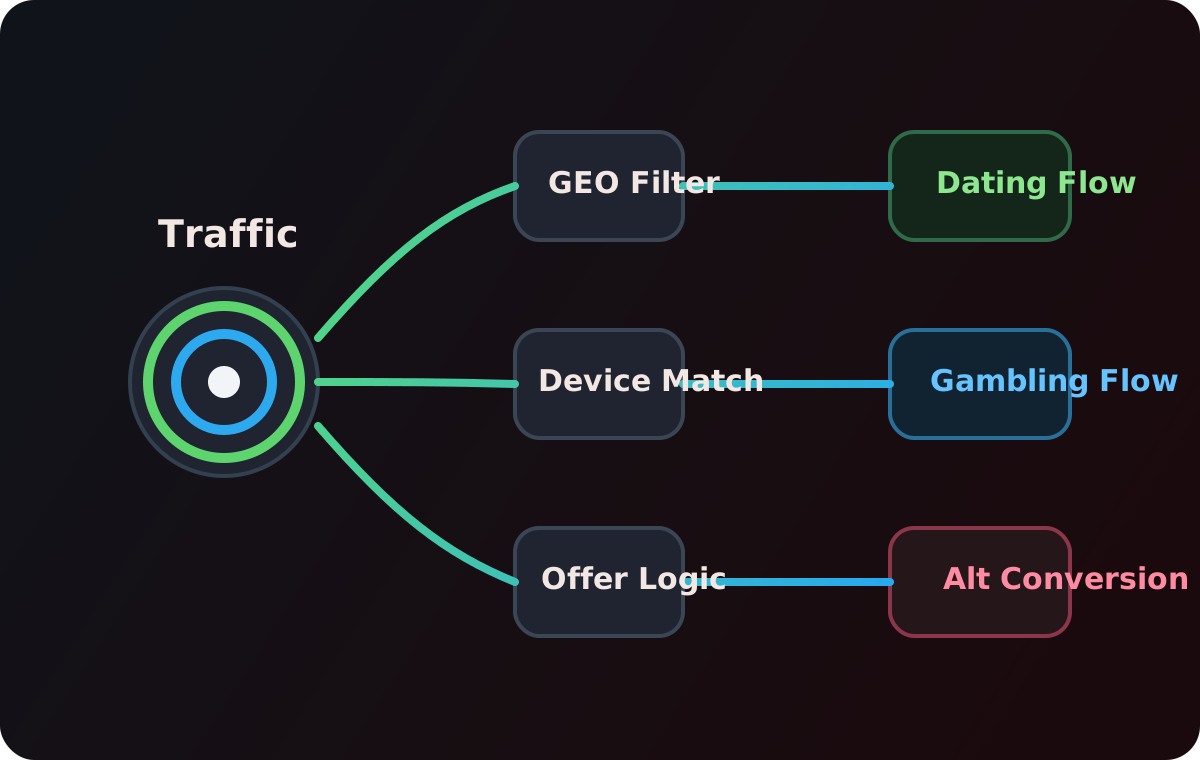
A dating smartlink helps route visitors to available offers by GEO, device, and other signals. That is useful when testing multiple countries, but it should not replace campaign analysis.
Affiliates should still track which sources and GEOs perform. Smartlink routing gives flexibility, while source-level reporting tells you where to scale.
Start with a controlled GEO set
Do not launch every Tier 2 GEO at once. Start with a small group of countries that match your traffic source and budget. This makes the data easier to read and prevents weak markets from hiding strong ones.
A clean first test might include three to five GEOs, separated by campaign or sub ID. After a few days, compare CR, approval rate, EPC, and advertiser feedback.
Local language and creative angle matter
Dating traffic is sensitive to language, culture, and user expectations. A generic creative may work poorly in a GEO that needs local tone. Even if the smartlink handles offer routing, creatives still need to match the audience.
Test local language variations, different age positioning, and mobile-first creatives. Many Tier 2 dating campaigns are heavily mobile, so the first screen experience matters.
Track source IDs aggressively
Scaling across Tier 2 GEOs without source-level tracking is risky. A campaign may look profitable overall while one or two sources create most of the approved value. Another source may produce clicks and signups but weak downstream quality.
Keep sub IDs clean from the first test. That way, when the network gives quality feedback, you can cut or scale specific sources instead of guessing.
- Track country, source ID, device, and creative angle
- Separate tests by GEO group
- Compare approval rate, not only conversion rate
- Cut weak sub IDs early
- Scale strong GEO-source combinations gradually
When to increase volume
Increase volume only after you see stable performance and quality feedback. For dating smartlinks, early CR can move quickly, but approval rate and advertiser response are better scaling signals.
If a GEO is stable for several days, expand budget, add similar sources, or test adjacent GEOs. Avoid doubling everything at once unless the advertiser confirms quality is strong.
How to group Tier 2 GEOs for testing
Tier 2 should not be treated as one large bucket. LATAM, Eastern Europe, MENA, Africa, and parts of Asia can behave very differently. Group GEOs by language, traffic cost, device mix, and offer availability. This makes testing more readable and helps prevent one weak region from hiding another strong one.
For example, a Brazil-focused test may need different language and creative logic than a Poland or Romania test. A smartlink can handle routing, but creative relevance still affects click quality and conversion intent.
Scaling without breaking quality
Once a GEO-source combination works, increase volume gradually. Sudden budget jumps can change traffic composition, especially on sources where cheap placements disappear quickly. A campaign that performs well at low spend may behave differently when pushed into broader inventory.
Scale by duplicating what works first: same source, same GEO, same creative angle, and same tracking logic. Then test adjacent GEOs or new creatives separately. This keeps the smartlink data useful and gives managers a cleaner quality picture.
FAQ
Are Tier 2 GEOs good for dating traffic?
Yes. Tier 2 GEOs often provide a useful balance between traffic cost, volume, and conversion potential.
Can smartlinks replace GEO testing?
No. Smartlinks help with routing, but affiliates still need source-level tracking and GEO-level analysis.
When should affiliates scale a dating smartlink?
Scale after several days of stable CR, acceptable approval rate, and positive quality feedback from the network or advertiser.
Final take
Dating smartlinks can help affiliates test and scale Tier 2 GEOs faster, but the best results come from structured testing. Start with a controlled GEO set, localize creatives, preserve source IDs, and scale only when both performance and quality are stable.
Learn how smartlinks work | Compare SOI and DOI models | Test dating traffic with CPAGEN